To price your products in dollars, start from your real costs, not your local price tag. Work out what each sale costs you in dollars, add a small currency buffer and the margin you need, check it against what buyers in that market expect to pay, then round it and review it on a schedule.
If you sell from Lagos, Nairobi or Accra, you've probably hit this already. Customers in London, Houston and Toronto ask how much your product costs, and you're not sure what to say.
Do you convert your naira or shilling price at today's rate? Round it up? Add something for shipping? And what happens next month when the rate moves?
This guide walks you through a five-step framework for setting dollar prices, with two worked examples: a physical product priced from Nigeria and a digital product priced from Kenya.
Why you shouldn't just convert your local price to dollars
It's the obvious move. Take your naira or shilling price, divide by today's rate, done.
But it causes problems fast:
- The rate keeps moving. Either your dollar price changes every week, or your margin quietly shrinks while the price stays put.
- Not all your costs are in your local currency. Ads, software, packaging and shipping are often paid in dollars. Your local price may not even cover them.
- Buyers abroad don't compare you to prices back home. They compare you to what similar products cost where they live.
- Odd numbers look unplanned. $13.47 tells a buyer the price was converted, not chosen.
A local price converted to dollars is a price built for a different market. You need one built for this one.
How to price your products in dollars: 5 steps
- List every cost per unit, in dollars. Production, packaging, shipping, customs, payment and platform fees, and the ad spend it takes to win one sale. For digital products, spread fixed monthly costs (hosting, software, tools) across the sales you expect. Convert any local-currency costs at a slightly weaker rate than today's, so a small dip doesn't eat your margin.
- Add a small currency buffer. A few percent on top of your costs (5% is a sensible start) gives you room when rates or supplier prices shift.
- Set the margin you need. Decide what you want to keep from each sale. Your costs plus that margin give you your floor price: the lowest you can go and still grow.
- Check what buyers in that market expect. Look at similar products on Amazon, Etsy or local stores in the country you're selling to. Far below them? You're leaving money on the table. Far above? Rethink your costs or how you position the product.
- Round it, publish it, and review on a schedule. Use price points buyers recognise, like $24, $29 or $49. Then review every quarter or when your costs change, not every time the rate moves.
Example 1: how to price a physical product in dollars (from Nigeria)
Say you run a skincare brand in Lagos and want to sell a face serum to customers in the US and UK. These numbers are for illustration only, using an example rate of ₦1,600 to $1.
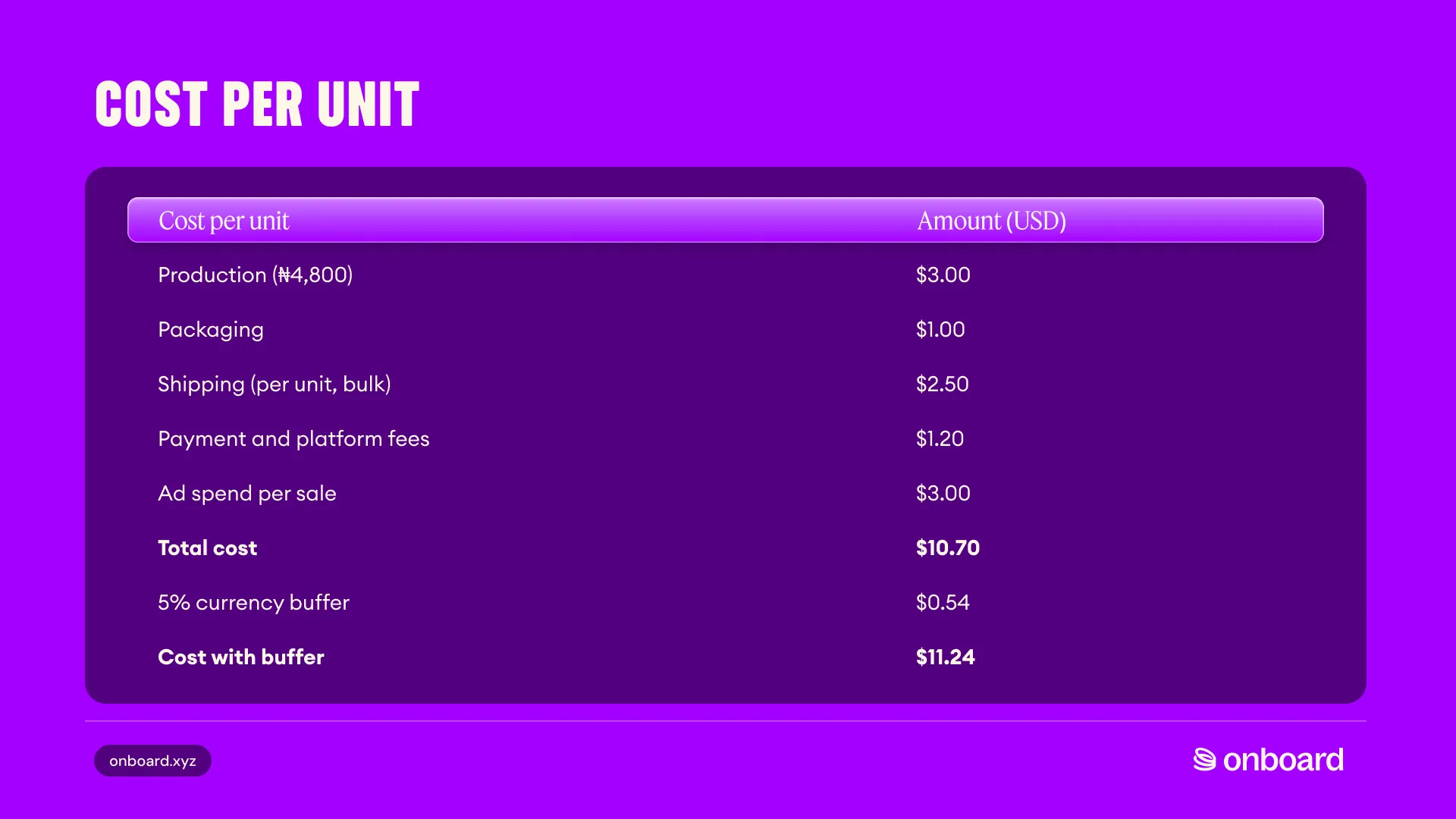
You want to keep about half of every sale, so you divide your cost by 0.5. That gives a floor price of $22.48.
Next, you check the market. Similar serums from independent brands sell for roughly $22 to $30. So you round up to $24, a price that sits comfortably in that range.
At $24, you keep about $12.76 per sale before tax. And because you priced from dollar costs, a weaker naira next month doesn't wipe that out.
Example 2: how to price a digital product in dollars (from Kenya)
Now say you're a bookkeeper in Nairobi selling an online course for small business owners in the US and UK. Again, these numbers are for illustration only, using an example rate of KES 130 to $1.
Digital products work a little differently. There's no shipping or packaging, and most of your costs are fixed each month. So you spread them across the sales you expect.
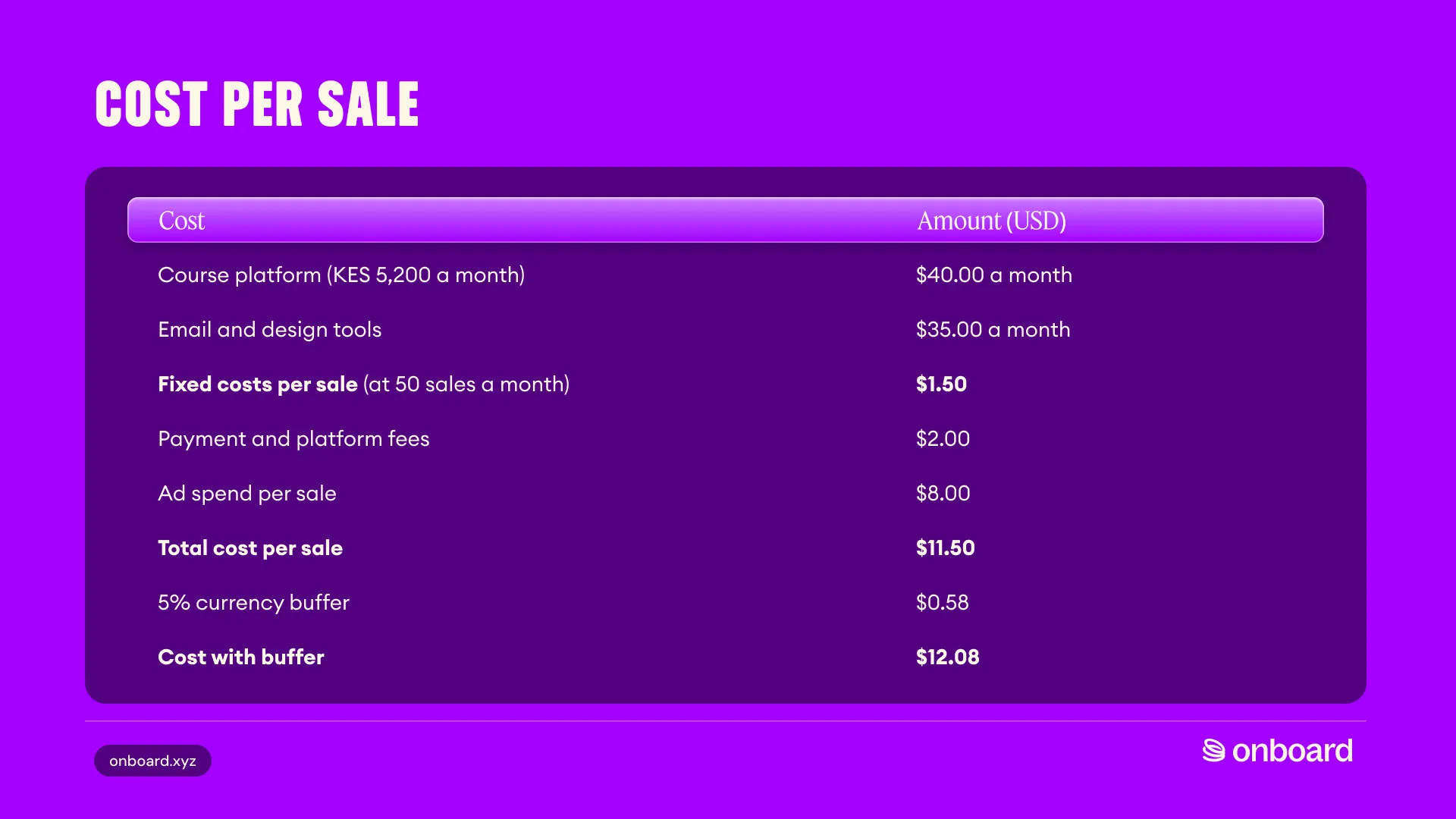
Digital products can carry higher margins, so you aim to keep about 75% of each sale. Divide your cost by 0.25 and your floor price is $48.32.
Similar beginner courses sell for roughly $49 to $79. So you launch at $49 and keep about $36.92 per sale before tax. As sales grow past 50 a month, your fixed cost per sale drops and your margin grows with it.
If you're already selling abroad, Onboard Business lets you receive payments in USD, EUR and GBP into one account, so the money arrives in the currency you priced in.
Common mistakes to avoid when pricing in dollars
- Changing prices every time the rate moves. Buyers notice. Review on a schedule instead.
- Forgetting the fees. Payment, platform and conversion fees add up. Put them in your cost list from day one.
- Underpricing to seem affordable. Price on the value you deliver, not on where you're based. Quality from Lagos competes anywhere.
- Ignoring shipping and returns. If you cover them, they belong in your costs. For digital products, the same goes for refunds and the fixed tools you pay for each month.
- Using one price for every market. UK buyers expect pounds. A clean GBP price, like £19, often converts better than a converted dollar price.
Frequently asked questions about pricing in dollars
Should I price in dollars or in my local currency?
If most of your buyers are abroad, price in their currency. Use dollars for the US and most international buyers, pounds for the UK and euros for Europe. Keep your local price for customers at home.
What exchange rate should I use to set my dollar price?
Use a rate slightly weaker than today's for any costs you pay in naira, shillings or cedis. That way a small dip in the rate doesn't eat your margin.
How often should I update my dollar prices?
Review them every quarter, or when your costs change. Changing prices every time the rate moves confuses buyers and makes your brand look unsettled.
How should I price a digital product in dollars?
Add up your fixed monthly costs, divide them by the sales you expect each month, then add per-sale costs like fees and ads. Digital products usually support higher margins, so aim higher than you would for a physical product.
Do I need a foreign bank account to get paid in dollars?
No. You can use global account details from a provider like Onboard Business to receive USD, EUR and GBP from customers abroad, without opening a bank account in each country.
How to get paid in dollars once your price is set
A dollar price only works if you can actually receive dollars. That's where a lot of businesses get stuck.
With Onboard Business, you can:
- Get global account details in USD, EUR, GBP and NGN, so customers abroad pay you like a local business
- Hold your earnings in USD, or pay out to local currencies like NGN, GHS and KES when you need them
- Pay for ads and tools in dollars with Corporate Cards funded from your USD balance
- Download receipts and statements for every payment, so your books stay clean
Want to see how it fits your business? Book a quick call and we'll walk you through it. Or, if you're ready, open your Onboard Business account today.
Set your price once, get paid in the currency you priced in, and spend your time on growth instead of maths.
Related Articles

Your borderless life awaits.