Since we launched Onboard Business, one request has come up again and again: being able to pay out in naira. For example, a freelancer platform wants its Nigerian users to be able to cash out in naira. A company in the Netherlands wants to pay salaries to its team in Nigeria without a week of bank delays. A remittance app in the US wants to help its users send naira home to their families.
Different businesses, same problem: they collect or hold dollars, pounds or euros, and the people they pay need naira. In most of those conversations, what we've recommended is our off-ramp product.
What is an off-ramp?
"Off-ramp" is crypto jargon, and most people outside crypto have never heard it. The meaning is simple, though: it's the step where digital money turns back into money in a bank account. In other words, a “cash payout”.
If a stablecoin like USDC is a digital dollar, a naira off-ramp is the service that takes those digital dollars and delivers naira to a Nigerian bank account. The person receiving it never touches crypto. They just see naira arrive.
We'll use naira as the example throughout, but the same works for other local currencies. Onboard also pays out in Ghanaian cedis, Kenyan shillings, Indonesian rupiah, and in US dollars, pounds and euros.
How it works the traditional way
Before off-ramps, there wasn't one standard way to convert foreign currencies to local currencies. Some businesses used informal agents, some asked recipients to sort it out themselves, and some built their own arrangements with banks. Two of the most common bank-based setups show where the problems are.
Setup 1: A company paying its team. Take the company in the Netherlands. Traditionally, sending money to Nigeria goes something like this:
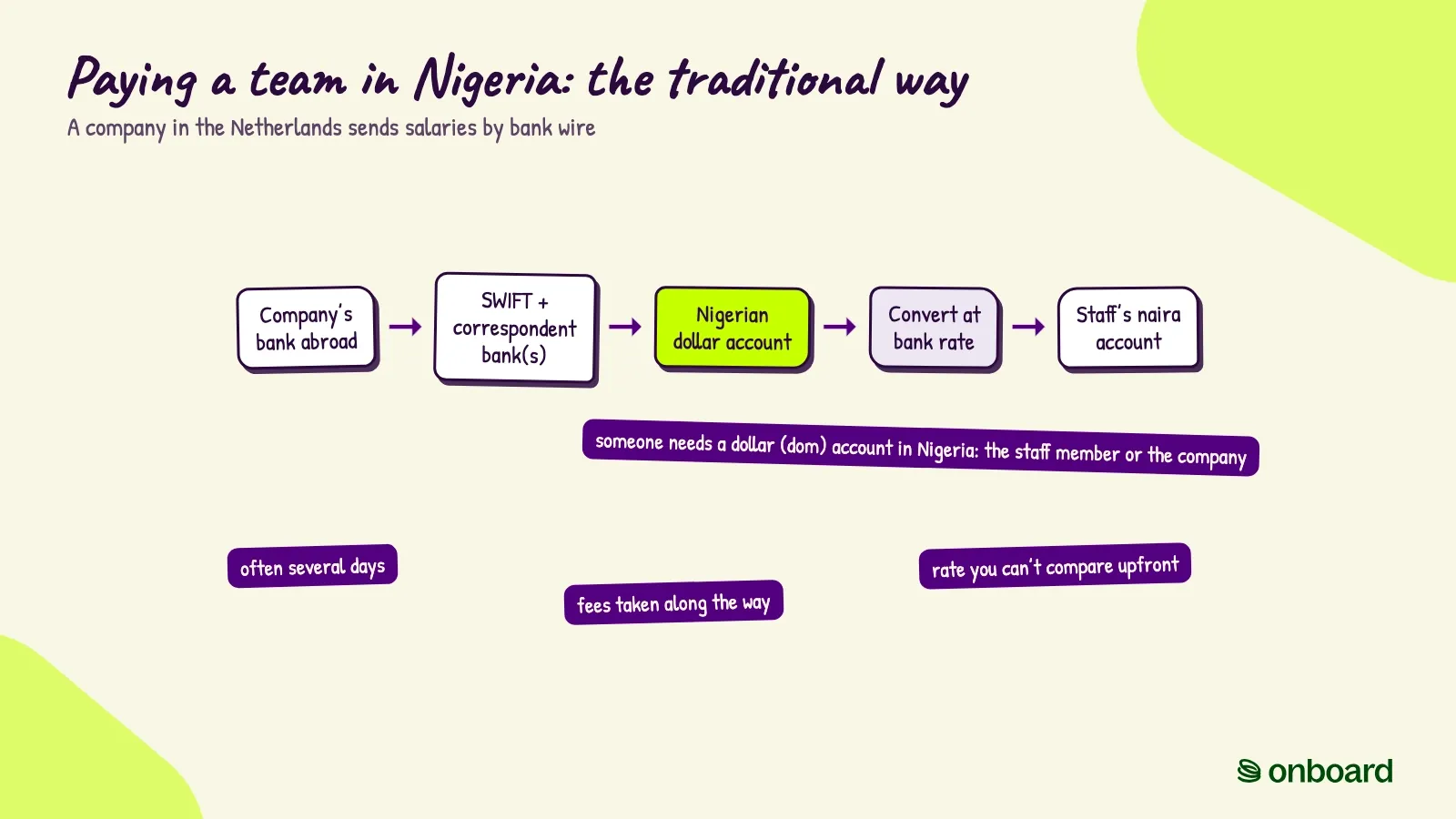
Traditional route: company's bank abroad, SWIFT and correspondent banks, a Nigerian dollar (domiciliary) account held by the staff member or the company, conversion at the bank rate, staff naira account
- The company sends a wire from its bank abroad.
- It travels through SWIFT and one or more correspondent banks.
- It lands in a dollar (domiciliary) account in Nigeria. So someone needs one: either each staff member, or the company itself through a local entity.
- Whoever receives it converts it to naira at their bank's rate.
- The naira finally reaches the account the staff member actually spends from.
Every step takes time, often several days in total. Fees come off along the way, so the amount that arrives is hard to predict. And the exchange rate is set at the end, by someone else, so you can't compare it upfront.
Setup 2: A remittance app paying families. A wire per transfer doesn't work when thousands of users are each sending $200. So remittance apps traditionally prefund: they park money in Nigeria before anyone sends.
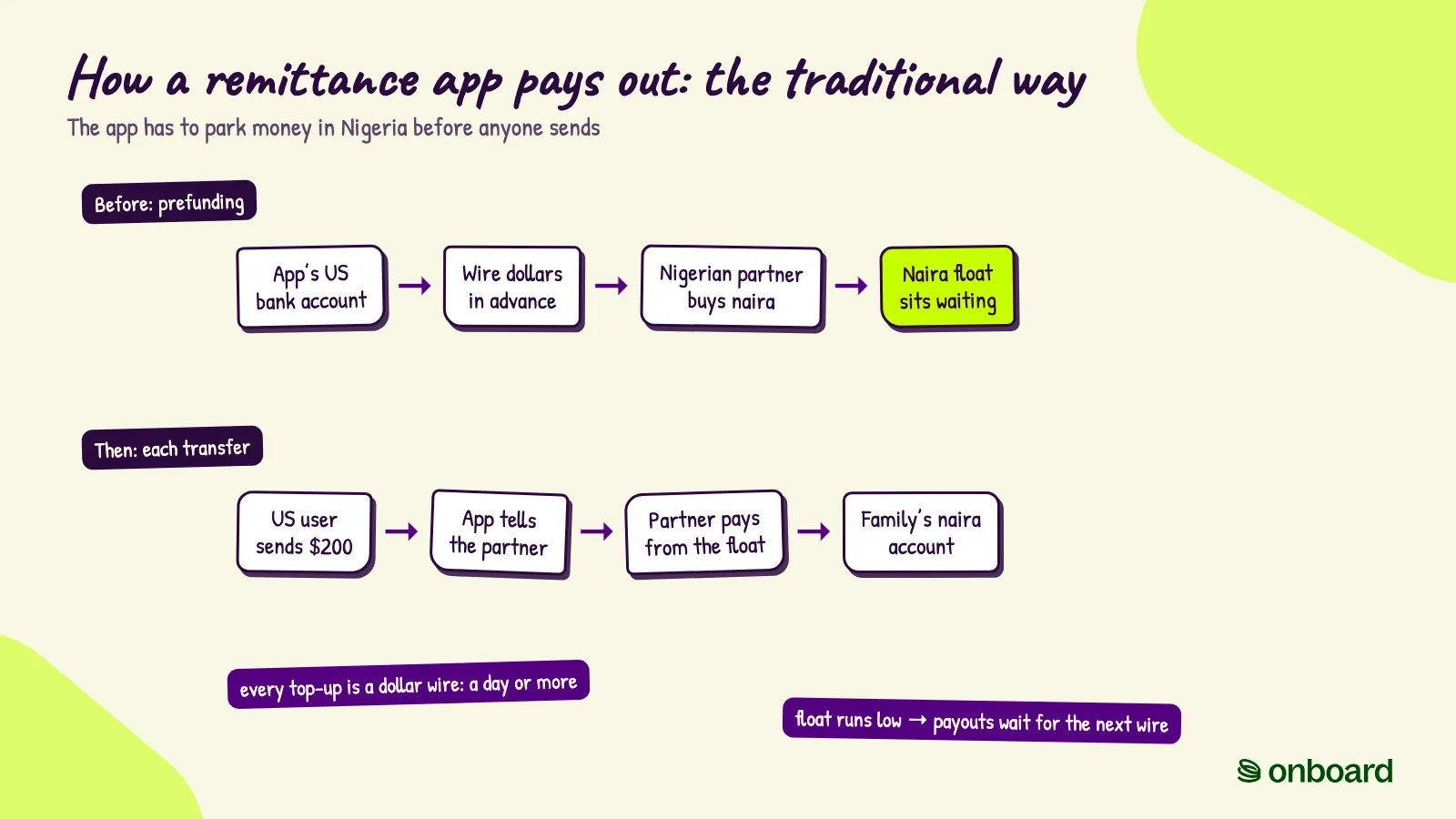
Remittance prefunding: the app wires dollars in advance to a Nigerian partner, who holds a naira float; each transfer is paid from that float; every top-up is a dollar wire taking a day or more
- The app wires dollars in advance to a payout partner in Nigeria.
- The partner converts them and holds a naira balance (a "float") for the app.
- When a user sends $200, the app tells the partner, who pays the family from that float.
- When the float runs low, the app sends another dollar wire and waits a day or more for it to land.
Transfers feel fast to the user, but the app pays for it: cash sits in Nigeria days or weeks ahead, exposed to the exchange rate, and if the float runs out before the next wire lands, payouts queue.
How it works with a stablecoin off-ramp
Both setups have the same weakness: the money spends a long time waiting. In the first, it waits in a chain of banks. In the second setup, every top-up is a dollar wire that takes a day or more, so the app has to send money well before anyone needs it.
A stablecoin off-ramp cuts out most of that waiting. Here's how a payout works with Onboard, whether you're paying one person or thousands:
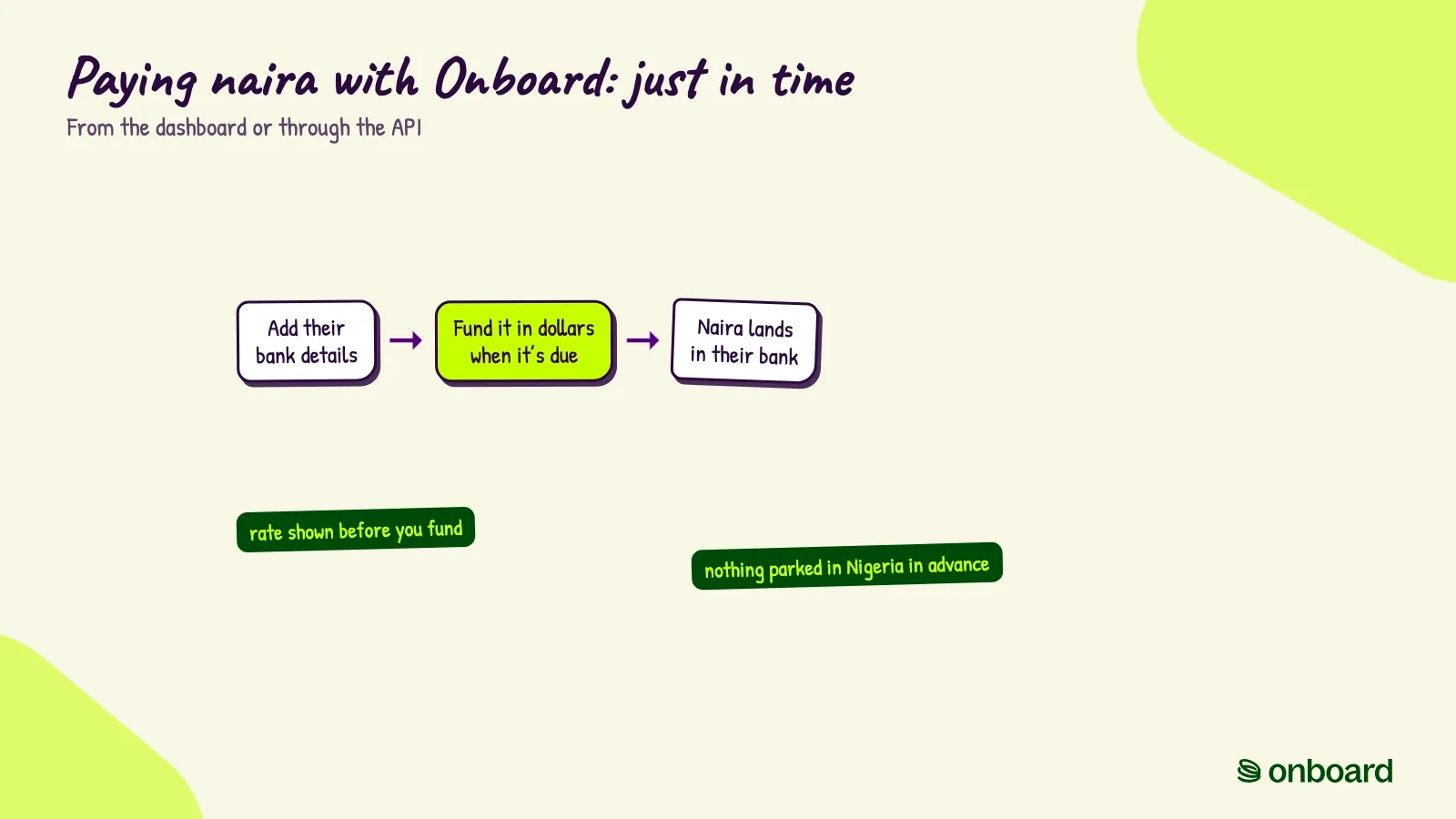
Paying naira with Onboard, just in time: add their bank details, fund it in dollars when it's due, naira lands in their bank
- Add the recipient's Nigerian bank details.
- See the rate and exactly how much naira they'll receive.
- Fund the payout only when it's due. Either pay from your Onboard balance, or, if you keep your dollars as USDT or USDC elsewhere, send just the amount for this payout to Onboard at that point.
- Onboard's local payout partners pay the naira from their own balances.
- The naira arrives in the recipient's bank account by a normal local transfer, and you get a receipt.
No dollar account in Nigeria, no chain of banks and no money parked ahead of time: you pay when the payout is due. You can do this from the Onboard Business dashboard, or build it into your own product with the Onboard API.
Someone still holds naira in Nigeria, of course: the local partners that pay the recipient. The difference is that their balances are topped up with stablecoins, which is much faster than waiting a day or more for a dollar wire, so they can keep pace with payouts instead of you funding them in advance.
Things to note
Off-ramps make paying in naira simpler, but a few practical things are worth knowing before you start.
- Rates move. A quoted rate only holds for a short time, so ask how long you have to confirm.
- If you fund with stablecoins, send on the right network. USDT and USDC run on several blockchains. Use the one your provider asks for, or the money can be lost.
- Expect checks. Your provider will verify you or your business, and the people you pay. That protects you too.
- Very large payouts at odd hours can take longer. A very large payout late at night or at a weekend may wait until the local partner's naira balance is topped up. Ask your provider how they handle it.
- Double-check bank details. Payouts go by account number and bank, so confirm the account name before you send.
- Look at what the recipient gets. Compare providers on how much naira lands in the account, not on the advertised fee. (More in ‣.)
- Keep a receipt for every payout, showing the rate and the amount delivered.
How to get started off-ramping with Onboard
As a business
- Fund your Onboard Business account with USD, GBP, EUR or stablecoins, then pay naira to any Nigerian bank account from the dashboard whenever a payout is due.
- Paying out from inside your own product, like a platform, payroll app or remittance app? Do the same through the Onboard API to quote, send and track naira payouts automatically.
Either way, the off-ramp happens behind the scenes.
As an individual
- Add USD, GBP, EUR or stablecoins to the Onboard app, then send naira to any Nigerian bank account whenever you need to. Each time you do, the off-ramp happens behind the scenes.
Common questions
Does the recipient need a crypto wallet when off-ramping? No. They receive naira in their normal bank account.
Do I need a dollar account in Nigeria to off-ramp? No. The off-ramp pays naira directly to a local bank account.
Does off-ramping work for other currencies? Yes. On Onboard, the same off-ramp model pays out in Ghanaian cedis, Kenyan shillings, Indonesian rupiah, and several other currencies.
How fast is a naira payout? On Onboard, usually in minutes - much faster than a bank wire. However, ask your provider for their typical times - it may vary based on the size of the payout and the time of day.
Is a naira off-ramp legal? Off-ramps run through licensed local partners and regulated providers. Rules are evolving, so use providers that are compliant and verify their customers.
Related Articles

Your borderless life awaits.